Showing posts with label trees. Show all posts

Saturday, September 3, 2016

WOOD

If any of the Macedon Bullises had been living at the time of the first Lumberjack Festival, they surely would have  been involved in some way, because they were known for their community  loyalty. No, they probably wouldn't have competed in the various events, but perhaps they would have shown their support by their attendance  or by sponsoring an event. They might even have offered some of the trees from their property to be used for the competitions. And this latter is where we drew a connection with the local festival and the Bullis family because there are several books on trees and wood in the Bullis Collection.

If you are also interested in this subject,  you'll want to look through these books that are on the shelves here in the Bullis Room:
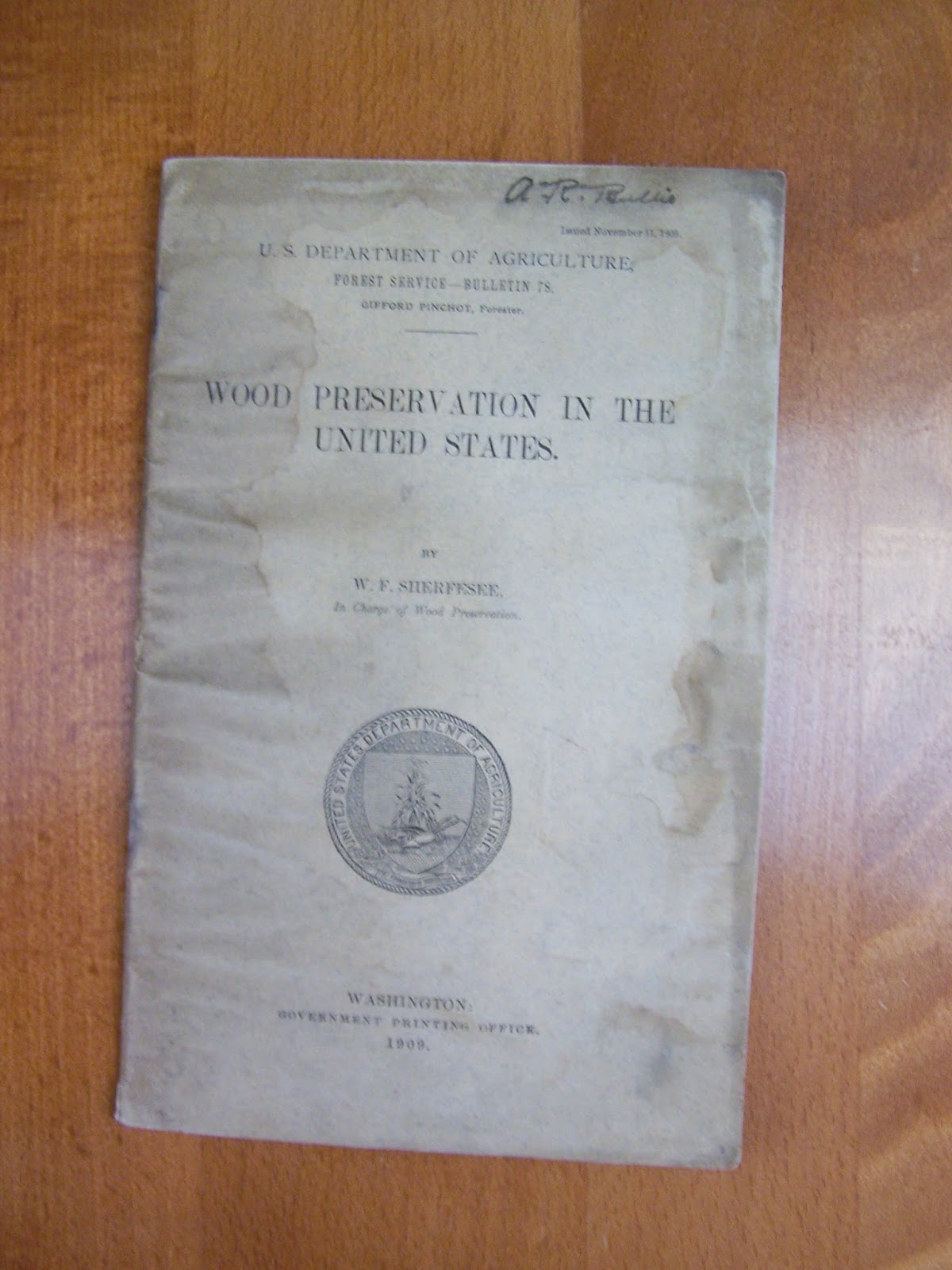
Wood Preservation in the United States
by W. F. (William Forsythe) Sherfesee
Published by U.S. Department of Agriculture, Washington D.C., 1909
Timber: An Elementary Discussion of the
Characteristics and Properties of Wood
by Filibert Roth
Published by U.S. Department of Agriculture, Forestry Division,
Washington D.C., 1895

Formulas and Tables for Architects and Engineers
in Calculating the Strains and Capacity of Structures in Iron and Wood
by Franz Schumann
Published by W. Choate & Co., Washington City, 1873


Strength Values for Structural Timbers
by McGarvey Cline
Published by U.S. Government Printing Office, Washington, 1912

So ... the next time you're in the library, consider spending some time with these books - or some others - in the Bullis Room.

Sunday, April 3, 2016

EARTH DAY

Earth Day is April 22nd. To honor this worldwide event that dates back to 1970, we are planning a display of some of the Bullis books and catalogs on gardening, farming, and landscaping.

Choosing which books to put in the display case is not an easy task.  There are so many volumes with interesting content and illustrations.  And although we've been cautioned not to judge a book by its cover, some of these older books have such decorative covers, it's hard not to instantly declare them "spectacular," before we've even opened them.  However, we're usually not disappointed when we do look inside and see the striking photographs and drawings.

Also, the content of these books is informative and helpful, even though it may be dated. For example, if you're thinking of planting some trees as an Earth Day observance, the Bullis collection has several books on that subject. And there is even a book on effectively using manure for fertilizing those new growths.

The Earth Day display should be ready by early next week. So please plan to stop by during April to feast your eyes on the colorful illustrations and to get some "old" tried-and-true ideas that you can use in a "new" way.


Friday, September 19, 2014

TREES

We volunteers have been talking a lot about trees the last few months--family trees, that is. But that started us thinking about the books in the collection on the subject of those things with trunks, branches, twigs and leaves. So we did a search and came up with several volumes that we are recommending to you for "leafing" through.

First, there's Our Native Trees and How to Identify Them; A Popular Study of Their Habits and Their Peculiarities. This book was written by Harriet Louise Keeler in 1900 and is a good one to reference if you want to identify a new tree sprouting in your back yard that doesn't look familiar.

There are two other books we recommend to you, if you're looking for a good reference on trees: Handbook of the Trees of the Northern States and Canada East of the Rocky Mountains, by Romeyn Beck, published in Lowville NY in 1907; and, A Guide to the Trees by American botanist Alice Lounsberry, published in 1900.   Lounsberry's book is especially enjoyable to look through because of the detailed illustrations by Mrs. Ellis Rowan.

So you are invited to stop by the Bullis Room and spend some time with these books (and others) on trees.  Hope to see you soon.


Friday, April 29, 2011

WHAT MAY BE LEARNED FROM A TREE

Since today is Arbor Day, we scrolled through the collection's data base for books on trees, and stopped when we saw the entry "What May Be Learned From a Tree."  Wow, what a neat book!  The author, Harland Coultas, copyrighted the book in 1855 and it went into several printings. The Bullis copy was published in 1860 by D. Appleton.

Mr. Coultas began his book with the history of trees and followed up with discussions of tree anatomy, physiology, growth, community, and death.  Interweaved throughout is the author's purpose "...to show that the tree may be regarded as a vast community of phytons, or plants, which co-operate in its construction and are mutually dependent on and subservient to each other." (Introduction, page 11)

He concludes his introduction with, "Reader, whoever you are, may this book prove to you a friend, may you be induced by its pages to look on the Tree with a new interest; and obtaining from its noble form a clear and truthful view of your own position and duty in life, become, by the perusal of this volume, a wiser man and a better citizen." (Introduction, page 12)

Many trees are visible through the Bullis Room window. Some were here long before us and will be here long after we are gone, making their contributions (individually and collectively) to our planet. Let's do what we can to help them live out their purpose.

Note: You can read Mr. Coulas's book online, or here in the Bullis Room.