Showing posts with label Civil War. Show all posts

Wednesday, May 17, 2017

JOHN LAPHAM BULLIS

Please plan to join us at  2 PM on May 24th in the Bullis Room at Macedon Public Library  as June Hamell  presents a program on John Lapham Bullis.

As you probably know from our many blog posts on John Latham Bullis, he was a distinguished and much-decorated soldier in the Civil and  Spanish-American wars.  

So ... You are invited to June Hamell's presentation on May 24 for the "rest of the story" of this great man.

Wednesday, November 9, 2016

November 11 is Veteran's Day

As the early forefathers of our country studied the different ways of governing, they were taken with the Seneca ways.  Their democratic ways served as inspiration for our constitution.  Our constitution is defended by brave men and women who respond to the call of military service.  Our freedom does have a cost.  Since the Revolutionary war, approximately 656,000 military personnel have died in battle.  There have been 1,478,000 non-mortal wounds in that time period.  And this statistic does not include the effects on families, on service members adjusting to domestic life, the lack of medical services sometimes, etc.  Freedom is not free!  And we thank those who have given of their lives to defend the U.S. Constitution.

The Bullis family collected many books on military service.  Charles H. Bullis had fought in the War of 1812 before he emigrated to Macedon in 1839.  His grandson, John Lapham Bullis, fought in the Civil War and the Indian Wars of the West.  And he participated in the Spanish-American War as a Paymaster in Cuba and the Philippines.  Granddaughter, Lydia, married Theodore Wint from Pennsylvania who fought in the Civil War and served in the west.  Granddaughter, Jeanette, married a Lt. who fought in the West and died in the Philippines.  Great-grandson, Charles, served stateside at the end of World War I.   Great-granddaughter, Anita, married into a military family and her son carried on the military tradition.  The family had many links to military service.

So we thank all of you who have served, given your time, your energy, sacrificed for this country, and placed duty to country ahead of personal lives.  Click for thank yous in Wayne County


Sunday, May 22, 2016

U.S. GRANT

Since our country is in the midst of another general election year, we've been looking through some of the Bullis books about past elections. This week, we focused on:

A New, Original and Authentic Record of the Life and Deeds of
General U.S. Grant
By Frank A. Burr
Published by H.B. Graves, Rochester N.Y., 1885

Included in the text is an account of Ulysses S. Grant's election to the presidency.  At their May, 1868 national convention, the Republicans  unanimously selected Grant as their candidate for the presidency. The 1868 election was the first following the Civil War and this nation was still in recovery from that devastating event.  The Republican party supported the Reconstruction plan set up following that war, while the Democratic party generally opposed the plan.  Grant's victory resulted in the original Reconstruction plan being implemented. (And one result of this was Congress's ratification of the Fifteenth Amendment, a/k/a the right to vote.)

Can books about past elections give us some perspective on the current campaign? We suggest that they can. Author Frank Burr's book is available for your use, during regular library hours.


Sunday, November 8, 2015

VETERANS DAY, 2015

This coming Wednesday, we have another opportunity to honor those who served in our military.  In order to get more familiar with this observance,  we suggest you revisit two Bullis Book Chronicles from previous years.


"HONORING VETERANS" (November 5, 2011)
http://bullisbookchronicles.blogspot.com/2011/11/honoring-veterans.html

This post relates some of the history of this observance,  originally designated as "a day to be dedicated to the cause of world peace ...."


And,

"FOR LOVE OF COUNTRY," November 11, 2014
http://bullisbookchronicles.blogspot.com/2014/11/for-love-of-country.html

The title of this post refers to a contemporary book, For Love of Country: What Our Veterans Can teach Us About Citizenship, Heroism and Sacrifice, by Howard Schultz and Rajiv Chandrasekaran.
How does this book connect to the Bullises?  The Bullis family  has a long and distinguished history of serving their country's military. Beginning with Philip Bullis, who served in Major Savage's Company during King Philip's War in 1675-1676; continuing with Charles Bullis who served in the Revolutionary War in the Vermont Militia; John Lapham Bullis, whose lengthy military career spanned the Civil War, Indian Wars, and Spanish-American War; and Charlie Bullis, who served in World War I. 


And now, a question for you: How can we show our appreciation to our Veterans? Here're a few suggestions:  Attend a Veterans Day event, fly a flag, write a card or email to some veterans thanking them for their service, or sit down with a veteran and listen to that person tell about his/her experiences.

Sunday, June 21, 2015

REMEMBERING THE CIVIL WAR

A new exhibit at the Rochester Museum  and Science Center - titled "The American Civil War: the Impact of the Industrial Revolution" - recently opened and will run through January, 2016. It commemorates the 150th anniversary of the end of the Civil War.  Many items are on display from the museum's collection, including: Civil War swords, rifles, tents, flags, diaries and photographs.

After you've experienced this interesting exhibit,  we invite you to take a look at this Bullis book:

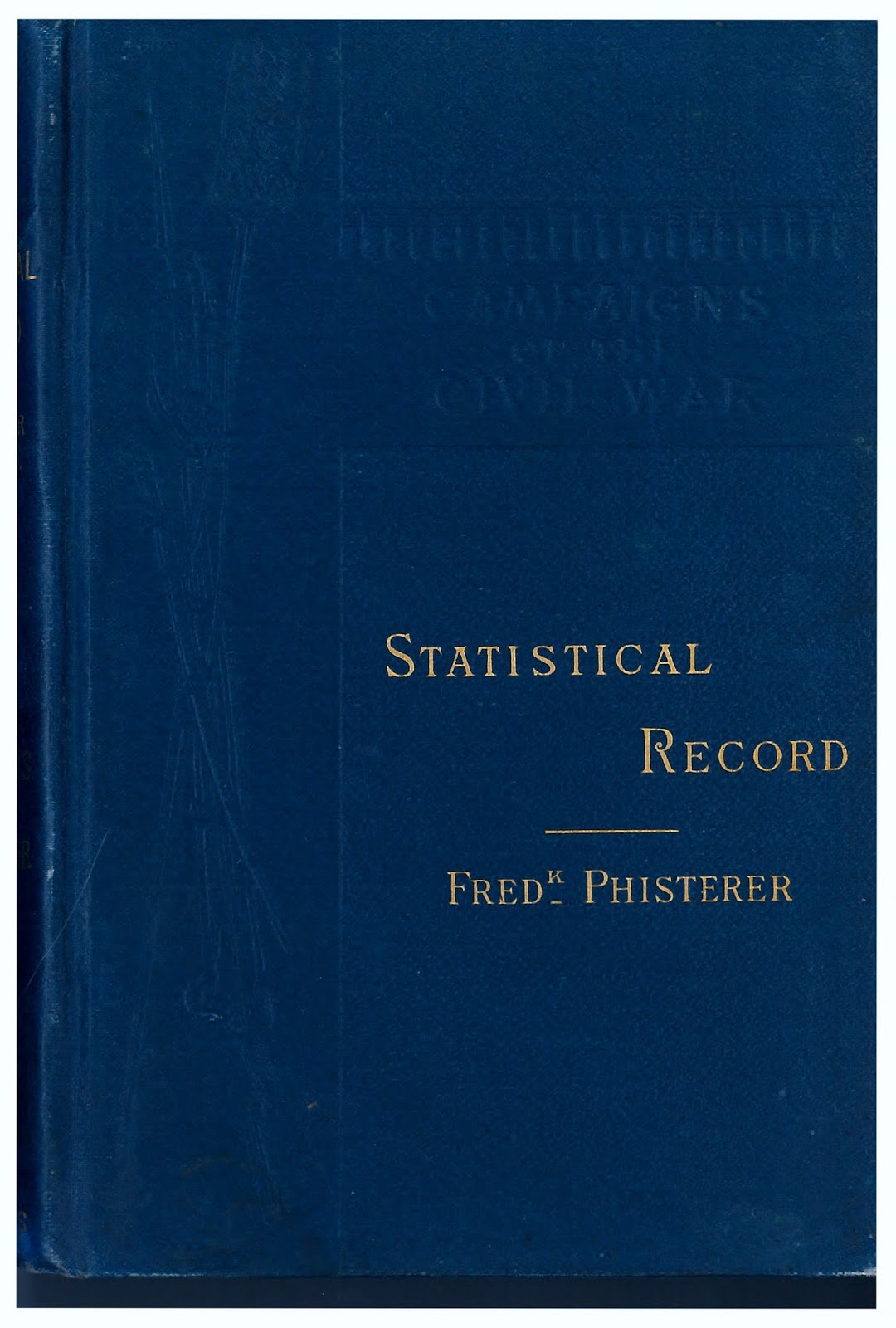
Statistical Record of the Armies of the United States
By Frederick Phisterer, Late Captain U. S. Army
Published by Charles Scribner's Sons, 1883

The comprehensive data in this book was "compiled from Army orders, registers of regulars and volunteers, reports of the Provost-Marshall, and the Adjutant-General U.S. Army, Medical History of the Rebellion, and other sources."

In Part I, the "Calls for Troops" on April 15, 1861 on page 3 shows data for 26 states, both their quota and men actually furnished.  Later  calls for troops are enumerated on several more pages, with a summary for the war on page 10. Military divisions, strength of the Army at various dates, as well as national cemeteries, are covered in the following pages.


Part II lists the chronological record of engagements,  battles etc. from 1861 to 1865, and general officers of the Armies during the "War of the Rebellion" are covered in Part III.

So there you have it - an exhibit and a book to enhance your knowledge and appreciation of the events of the Civil War. (And there are more books on the Civil War in the Bullis collection. We're always glad to help you access them.)


Tuesday, April 22, 2014

ANOTHER LETTER

We're continuing to look at letters in the collection. Below is one from Nettie Bullis's uncle, John Lapham Bullis, who distinguished himself in the Civil War and then continued his military service in the Southwest. Six months before he wrote this letter to Mr. Hoyt, he was breveted a Major in the U.S. Army "...for Gallant services in action against Indians, near Saragossa, Mexico, July 30, 1876, and in action against Indians, in the Burro Mountains, Mexico, May 3, 1881." (The Army and Navy Courier, November, 1926, "The Border Command--Camp Bullis" by Col. Martin L. Crimmins, U.S.A. Retired)

We have not identified the letter's addressee, as far as his connection to the writer or the Bullis family in general. The text indicates a personal as well as business relationship. And John Lapham Bullis felt free to briefly express, in a "p.s.",  his regard for Mr. Hoyt and his loved ones. They must have received this news with mixed feelings--relief that he was safe at the time of writing but concerned that he was in a dangerous place, hoping "...to reach civilization after a time."

"San Carlos Indian Agency, Arizona,
September 16th, 1890


"For Mr. William B. Hoyt,
Attorney At Law,
Buffalo, Erie County, New York

My Dear Sir:-

Yours of the 3rd inst. received and contents noted.

Replying:

Within a few days, I expect to go to the Railroad, on my way to Texas, for a short trip, and as soon as I reach a Notary I will have a Power of Attorney made out in your name and will mail to your address, at Buffalo with the least possible delay, so as not to delay the process of the law.

Very Truly Yours,
(Signature: John L. Bullis)

P.S. Much love to all. Have had a very hard time here with the Apaches, all of whom are very wild. Have never worked as hard, hope to reach civilization after a time, and if so may then  have the pleasure of meeting you again.Yours.etc. (Initials: J.L.B.)"

Monday, May 20, 2013

WOUNDED WARRIOR PROJECT

There have been several posts on this blog about Nettie Bullis's Uncle John Lapham Bullis who fought in the Civil War and continued his military career on the western border. His contributions were recognized in many ways, including the naming of Camp Bullis in his honor.

We thought of John Lapham Bullis this week when we heard about the Friends of Macedon Public Library scheduling a June 19 presentation of the Wounded Warrior Project. Mr. Bullis, we feel sure, would have supported such a project in his day, not only because he himself was wounded in the Civil War but also because he was so conscientious about caring for his comrades who suffered such a fate.

We encourage you to come to this presentation  on June 19, 6 PM, here in Macedon Public Library's Community Room.  LCpl. J.M. Gonzalez will explore the project's mission (to honor and empower Wounded Warriors) and its purpose (awareness, enlist public support,  help injured servicemen and women aid and assist each other, and provide unique and direct programs and services. He will also include general background on the organization.

We hope to see you on June 19. And in the meantime, please tell others about this presentation.

Monday, January 28, 2013

THE STORY OF THE GREAT MARCH

We have a suggestion for all of you interested in the Civil War - stop by the Bullis Room and ask to take a look at the book The Story of the Great March by George Nichols, published in 1865.

"This is the Civil War diary of Major George Ward Nichols, aide-de-camp to General William T. Sherman during the latter part of the war. It is a personal story, describing his experiences during Sherman's March to the Sea and the subsequent march through the Carolinas.
  "For a personal journal it is surprisingly well written and describes this journey as a decidedly uncertain endeavor. Written in the vernacular of the time, it provides a unique insight into the operations and risks associated with the most singular military event of the war."

Illustrations, plates and a folding map aid in the reader's appreciation of this event. You won't be disappointed.

Wednesday, May 2, 2012

GONE WITH THE WIND

An item from a "this-date-in-history" column caught our eye this week. On May 3, 1937, Margaret Mitchell won the Pulitzer Prize for her novel Gone With the Wind. And now, 75 years later, her work still stands as one of the great pieces of American literature of all times.  There is a copy of this book in the Bullis Collection. And the collection also contains a significant number of non-fiction books on the War Between the States that Margaret Mitchell skillfully fictionalized.

So ... if you are interested in learning more about the Civil War, we invite you to stop by the Bullis Room and look at some of these books.  And we also invite you to read (or reread) two of our 2011 posts in which we recorded John Lapham Bullis's eyewitness accounts as a young recruit, taken from his letters home to his family.  (See our April 8, 2011 and April 15, 2011 posts.)

We hope you find one or more of these sources of Civil War history interesting and informative.


Saturday, November 5, 2011

HONORING VETERANS

This week our volunteers assembled books, pamphlets, posters, photos, and medals to include in a display case outside the Bullis Room. Here is one of the posters included:

(Lower caption reads: "Supplement to Engineering News Record, November 19, 1917."

As we worked on the display, we wondered about the history of this holiday, so we consulted Wikipedia's Veterans Day article and learned that November 11 "...is also celebrated as Armistice Day or Remembrance Day in other parts of the world...."  The article also reminded us that on November 11, 1919,  President Woodrow Wilson proclaimed Armistice Day as a holiday. President Calvin Coolidge issued another proclamation in 1926 that called for November 11 to be observed with appropriate ceremonies, and in 1938 Congress proclaimed November 11 a legal holiday, "a day to be dedicated to the cause of world peace and to be thereafter celebrated and known as 'Armistice Day'." Finally, 
in 1953, an Emporia, Kansas shoe repair shop owner "had the idea to expand Armistice Day into 'All' Veterans Day...." With the help of U.S. Representative Ed Rees, also from Emporia, a bill for the holiday was pushed through Congress. "President Dwight Eisenhower signed it into law on May 26, 1954. Congres amended the act on June 1, 1954, replacing 'Armistice" with 'Veterans,' and it has been known as Veterans Day since."

On this November 11 as you celebrate in your own way, whatever that might be, we suggest you also stop by the library and look at our display. The case's contents are only a small part of similar items in the collection. If you'd like to see more, please feel free to stop by.

Thursday, July 28, 2011

THIS WEEK IN HISTORY

Two items grabbed our attention this week when we looked over one of those "this week in history" lists:

1. On July 27, 1866: "Cyrus W. Field finished laying out the first successful underwater telegraph cable between North American and Europe (a previous cable in 1858 burned out after only a few weeks' use)."

and

2. On July 25, 1866: "Ulysses S. Grant was named General of the Army of the United States."


We searched the Bullis archives for information on both these subjects and came up with nothing on the first (but we're still looking!) and lots of stuff on the second.

Here's what we found when we did a search on General Grant.  There are six books on the subject in the collection.  All of them are worth our time to at least scan through, and some of them warrant a serious read. Here's a list and we offer it to you for your reference and consideration for further reading:


Military History of Ulysses S. Grant: from April, 1861 to April, 1865, by Adam Badeau, published by D. Appleton in 1881.

The Travels of General Grant, by Joel Tyler Headley, published by New World Publishing, in 1881.

A New, Original and Authentic Record of the Life and Deeds of General Ulysses S. Grant, by Frank A. Burr, published by H. B. Graves in 1885.

The Life of Ulysses S. Grant: General of the Armies of the United States, by James Harrison Wilson, published by Gurdon Bill & Co., in 1868.

Personal Memoirs of U.S. Grant,  by Ulysses S. (Ulysses Simpson) Grant, published by C. O. Webster & Co. in 1885-86.

A Personal History of Ulysses S. Grant: with a portrait and sketch of Schuyler Colfax, by Albert D. Richardson, published by American Publishing Co. in 1868.

You'll find  maps, facsimilies, prints, and illustrations in these books. And a lot of good reading. Enjoy.


(P.S. Why is there a sketch of Schuyler Colfax included in the last book listed above? Who was he?)

Friday, November 12, 2010

REMEMBERING AGAIN THOSE WHO SERVED

This week, we again remember and sincerely thank all the men and women who have served and are serving in our Armed Forces.

And we suggest that you look at our November 12, 2009 post, which lists some Bullis family members who served their country through military service beginning in 1675.  The most well-known of those members is John Lapham Bullis, who proved himself militarily in the Civil and Spanish American wars as well as on the American frontier.

Friday, October 22, 2010

CONTRASTS: THEN AND NOW

We met this week with two women who had recently visited San Antonio and John Lapham Bullis's former home. (The latter is now a bed and breakfast named Bullis House Inn.) As they described the house's 14-foot ceilings, the elegant plaster medallions, marble fireplaces, rich oak floors and stairways that are a part of the 11,000 square-foot structure, we thought of the modest home here in Macedon where he grew up and the contrast between the two.

General Bullis's early life with his family here in Macedon and that of a successful military man also indicate a wide contrast. The records we have indicate that  John Lapham was known simply as "one of those Bullis boys" in his hometown. That quickly changed when he entered the army at age 20, served in the Civil War, and rose from private to captain in three years. Then came his life on the Texas frontier, leading the group known at that time as the Seminole Scouts in a successful war against hostile Indians.  General Bullis received national attention and recognition as a result of his frontier military accomplishments, something that no one in his home town likely ever envisioned.

As we continue our work on General Bullis's timeline, we are finding other contrasts that cause us to stop and ponder, trying to reconcile the "then" with the "now."  As we learn more about this great man, we'll share it will you. And if you'd like to know more about any of the family members or the Bullis book collection, we invite you to make arrangements to meet one of our volunteers in the Bullis Room.

Thursday, June 3, 2010

NAPOLEON BONAPARTE

On April 17, 1864, while stationed at Annapolis during the Civil War, John Lapham Bullis wrote a letter to his mother in which he stated that he was reading "Victor Hugo's sketches of Napoleon." This reference caused us to wonder if the book Mr. Bullis referred to might possibly be a part of the current collection, so we searched our data base for all things Napoleon.

We did not find any book about Napoleon that Mr. Bullis could have been reading in 1864, but there are several in the collection that he might have read at a later time, such as:

The Destroyer of the Second Republic; Being Napoleon the Little
by Victor Hugo
published in 1870

Recollections of the Private Life of Napoleon
by Louis Constant Wairy
published in 1900

Napoleon, the Last Phase
by Archibald Philip Primrose, Earl of
published in 1900

Memoirs of the Emperor Napoleon, from Ajaccio to Waterloo, as
Soldier, Emperor, Husband
by Laure Junot Abrantes, duchesse d'
published in 1901

The Life of the Empress Josephine, First Wife of Napoleon
by P. C. Headley (Phineas Camp)
published in 1850

Mr. Bullis's reference to Napoleon also caused us to wonder why he was interested in that particular military and political leader. Perhaps he wanted to learn from Napoleon's successes and mistakes? Or was it simply to distract himself from the realities of the war he was involved in at that time? Putting aside the reason for his choice of reading material, we find it characteristic that a member of the Bullis family would have in his possession a book that he was reading at any opportunity. Obviously, like all the Bullises, John Lapham Bullis was a true book lover and avid reader as well as a military genius.

Sunday, April 25, 2010

THE LOCAL BOY WHO BECAME BRIGADIER GENERAL

Two weeks ago our post was about a boy born in Kentucky who rose from humble beginnings to be our sixteenth president. Today we focus is on a boy born in Macedon who rose from a conservative small-town environment to be appointed a brigadier general by President Theodore Roosevelt in 1904.

John Lapham Bullis's biographical information is in two previous posts on this blog (see February 5 and 12, 2009). Our focus today is on his family's (and hometown's) reaction to his military and business achievements.

Since he received a standard Quaker education, questions have been raised about his family's feelings toward his military career. We have no record specific to these questions. However, we do have excerpts of letters Mr. Bullis wrote his mother while he was serving in the Civil War which indicate mutual love and support. We also have Christmas letters he wrote to his aunt, in which he enclosed a generous monetary gift and expressed his affection of her. As for his business achievements, his nephew Charles Bullis spoke about his Uncle John "always trying to earn money and get ahead...," indicating admiration for his uncle's apparent driving force and ambitions.

Again, we have no record of his community's reaction. However, Bullis family neighbors and friends must have felt proud as stories circulated in the local press and area grapevines about this hometown boy's accomplishments in the Civil War and, later on, in the Texas frontier as leader of the Black Seminole Indians. And we can imagine that after hearing stories of John Lapham Bullis's many acts of bravery, local young people may have been inspired to set higher goals and work harder to achieve them.

Next week we'll post excerpts from a 1981 article in True West titled "John Bullis."

Thursday, November 12, 2009

HONORING VETERANS

Again, we remember Bullis family members who have served their country through military service.

Philip Bullis, born circa 1630 in England. Philip was a mariner who immigrated to Boston, Massachusetts. He served in Major Savage's Company under Lieut. Gillam from 1675 to 1676 on the Connecticut River during King Philip's War.

Son of John Bullis, born circa 1695 in Dutchess County, New York. John married and had eight sons who grew up on the Bullis Homestead in Dutchess County. One of these sons was a general in the French and Indian War.

Charles Bullis, born 1723 in Greenwich, Connecticut. He later moved to Manchester, Vermont. He served in the Revolutionary War in Captain Gideon Brownson's Company, Warner Regiment, Vermont Militia.

John Lapham Bullis, born 1841 in Macedon, New York. In 1862, he enlisted in the Volunteer Army and was commissioned in 1864, seeing extensive service during the Civil War. He continued his military service in Texas and Mexico with the Buffalo Soldiers, served in the Phillipines and Cuba during the Spanish-American War, and ended his career after President Theodore Roosevelt appointed him Brigadier General in 1904.

Charles R. Bullis, born 1891 in Macedon, New York. He enlisted in the Army on September 26, 1917 and was discharged on December 11, 1918. He served as a Private in the 20th Company, 157 Depot Brigade during World War I. He was stationed at Camp McClellan, Alabama, for part of that time.

To these Bullis men and to all the men and women who have served and are serving in our Armed Forces, we once again say a sincere “Thank You

Thursday, February 12, 2009

BULLIS FAMILY HISTORY, PART II

JOHN LAPHAM BULLIS, From Corporal to Brigadier General

After the surrender of Lee, Corporal John Lapham Bullis's unit was ordered to Texas (along the Rio Grande River, near Brownsville) for Reconstruction duty. He was mustered out of the Volunteer Army on February 6, 1866 at White's Ranch, Texas, after serving almost three and a half years in the War of the Rebellion.

He attempted a personal business of providing logs for the steamboats on the Mississippi for about a year. It was said that civilian life just did not provide as much excitement as military life provided and he entered military service again. He was appointed 2nd Lieutenant in the 41st Infantry, September 3, 1867. This duty permitted little opportunity to advance, so in November, 1869, he requested transfer to the new Twenty-fourth Infantry, composed of white officers and black enlisted men.

With the Twenty-fourth Infantry, he participated in operations against Indian raiding parties and cattle rustlers. While stationed at Fort Clark (150 miles West of San Antonio along the Rio Grande) he received command of a special troop of Black Seminole Scouts. In 1873 and 1874, Bullis and his 20 scouts played a major support role to Col. Ranald S. Mackenzie as he battled against tribes from the Texas Panhandle and Mexico. He received brevet citations for his "gallant service" in the years of 1875 through 1881 and the title of "friend of the frontier" from the state of Texas. He left the Black Seminole Scouts in 1882 for other duties in Indian Territory.

In 1888 he served as agent for the Apaches at San Carlos Reservation. He was transferred to Santa Fe, New Mexico in 1893, to act as agent for the Pueblos and Jicarillo Apaches. In 1897, he returned to Texas as Major Bullis and was appointed paymaster at Fort Sam Houston. He saw service in the Philippines during the Spanish-American War. After forty years military service, President Theodore Roosevelt appointed him brigadier general in 1904 and the next day he retired.

We know less of his personal and civil life than his military career. He married Alice Rodriguez of San Antonio in 1872. She died in 1887 and he married Josephine Withers of San Antonio in 1891. In 1885, during his first marriage, he became one-third owner of Shafter Silver Mines of Presidio County, Texas.

John Lapham Bullis died in San Antonio, Texas on May 26, 1911.

Places named in his honor:
1) Bullis Gap Range, a ten-mile chain of peaks near the Rio Grande
2) Camp Bullis, a military training base near San Antonio, posthumously, in 1917
3) Bullis, Texas, a Southern Pacific Railroad station founded in 1882 as a siding and nonagency station and abandoned by the railroad after 1944


NOTE: Information contained in this article is from the STATEMENT AS TO THE MILITARY RECORD IN THE UNITED STATES ARMY OF BREVET MAJOR JOHN L. BULLIS, 24TH INFANTRY, U.S. ARMY and other family papers.

Thursday, February 5, 2009

BULLIS FAMILY HISTORY, Part I

JOHN LAPHAM BULLIS:

Student, farm hand, sheep herder, trapper, business man, soldier, war hero--all of these terms describe Nettie and Charlie's Uncle John. Born in Macedon on April 17, 1841 to Dr. Abram R. and Lydia P.(Lapham) Bullis, he was the eldest of seven children.

Only limited information is available about his early years. We know he received the standard Quaker education at academies in Macedon and Lima. Notes taken during a conversation with Charlie Bullis about his Uncle John tell us:

"In his teens John Bullis went trapping in Canada to earn money.
Before going to Civil War had a horse and a flock of sheep. Always
trying to earn money and get ahead - plowing for his uncle, Stephen
Lapham, when he went to war (either at the first call or on 21st
birthday).

Went to school at Lima Seminary, at Lima, New York. At end of Civil
War, he was in civil life about a year and in business on the
Mississippi River where he bought timber and hired men to cut it up
and sold it for fuel in steamboats of Mississippi River...."

John Bullis's long and successful military career is well documented and tells of his loyal service that included many acts of bravery. He began as a corporal in the 126th New York Volunteer infantry on August 8, 1862. During the Civil War, at Harper's Ferry in September, 1862, he was wounded and captured, surrendered to Stonewall Jackson, then exchanged. At Gettysburg, on July 1-3, 1863, he was again wounded and captured at Pickett's Charge. This time he spent two or three months in Richmond, Virginia's Libby prison before again being exchanged. He was discharged from the service August 17, 1864, to accept an appointment as Captain in the 118th United States Infantry, Colored Troops, dating from August 18, 1864.

Captain Bullis and his regiment participated in a number of major combats with small forces of Confederates while being recruited near Owensboro, Kentucky as well as several combats near Fort Harrison, Virginia in the winter of 1864 and 1865. At Dutch Gap canal, in the spring of 1865, they were under fire almost continuously for about three months.

CONTINUED NEXT WEEK: More of John Lapham Bullis's military service and civil life.

NOTE: Information contained in this article is from the STATEMENT AS TO THE MILITARY RECORD IN THE UNITED STATES ARMY OF BREVET MAJOR JOHN L. BULLIS, 24TH INFANTRY, U.S. ARMY and other family papers.