


The birth announcement shown in our last post has generated several questions. Among them is the significance of the baby's given names--Dorothy and Josephine--and the year of birth.
Nettie and Charlie's mother was named Josephine, so it's possible that is the source of the baby girl's middle name. But what about that first name? We have not found any Dorothy's in the immediate Bullis family tree.
Could the Knapps have been influenced by L. Frank Baum's book, The Wonderful Wizard of Oz? It was published in 1900, and the movie version premiered in 1939. According to the official website of the Social Security Administration, Dorothy was the second most popular baby girl's name in 1920 and the third most popular in 1930.
So, if the Knapps followed the "naming trend" of their time, was Dorothy Josephine born between 1900 and 1930? Perhaps ... but honestly, we can't say for sure.
And then there's that movie star, Dorothy Lamour, who was popular in the late 1930s through the 1950s. Hmmm - oh well.
It's fun to think about and to do some "what ifs," but when all's said and done, we have to return to our original premise: we do not know. However, this is the kind of thing that keeps us volunteers fascinated with the history of the Bullis family. So we'll keep on with our speculating and let you know when we come up with some answers.
Sunday, September 6, 2015


Wednesday, August 26, 2015
LOOK WHAT WE FOUND!
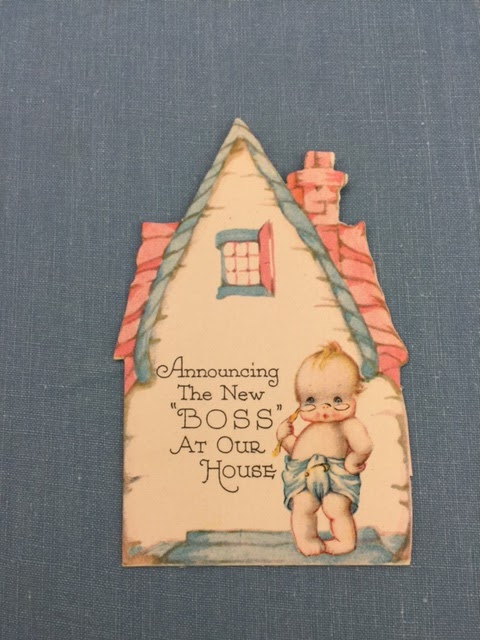
Volunteers continue to sort through a group of documents, letters, and cards that found their way to the Bullis Room recently. And this week they found a birth announcement. There is no year indicated, so we can't determine when this blessed event occurred. However, the parents were obviously very proud of the new addition to their family.
Inside, the card reads:
"My name is Dorothy Josephine
I'm the new Boss at
The Knapps
Mr. and Mrs. T. H. Knapp
are my new parents
I arrived on July 16th
My weight is 9 pounds
Come and See Me!"
(And you can "Come and See" the original card in the Bullis Room. Please stop by sometime.)
Monday, August 17, 2015
POSTCARDS
If you're one of those people who remember when you could mail a postcard for one penny, then you'll need to take a look at the display case outside the Bullis Room.
(And even if you can't remember back that far, we think you'll enjoy spending a few minutes at the same place.)
The postcards displayed there were ones sent to Nettie Bullis from friends who were vacationing in: New York state; New York City; Boston, Massachusetts; and Canada. Most of them have very short messages, the "wish you were here" kind. All of them have beautiful photography on sturdy matte paper that seems to be just a cut above most contemporary postcards.
So please add "stop by MPL and look at Bullis postcard display" on your to-do list. They are a reminder of what we miss out on today, with text messages and selfies.
(And even if you can't remember back that far, we think you'll enjoy spending a few minutes at the same place.)
The postcards displayed there were ones sent to Nettie Bullis from friends who were vacationing in: New York state; New York City; Boston, Massachusetts; and Canada. Most of them have very short messages, the "wish you were here" kind. All of them have beautiful photography on sturdy matte paper that seems to be just a cut above most contemporary postcards.
So please add "stop by MPL and look at Bullis postcard display" on your to-do list. They are a reminder of what we miss out on today, with text messages and selfies.
Wednesday, August 5, 2015
GLACIERS
If you've been reading the almost-daily news headlines reminding us of the melting glaciers on our planet, you'll be interested in these two Bullis books by John Tyndall:
Tyndall was a 19th century physicist and professor of physics at the distinguished Royal Institute of Great Britain. In addition to teaching, he did research and authored 18 books, 10 of which are in the Bullis Collection.
We urge you to stop by the Bullis Room and spend some time with these books. Both of them have numerous illustrations, and Hours of Exercise in the Alps has some very informative information on:
Forms of Water in Clouds and Rivers, Ice and Glaciers
by John Tyndall (1820-1893)
Published in New York, D. Appleton, 1874, c 1872
and
Hours of Exercise in the Alps
by John Tyndall (1820-1893)
Published in New York, D. Appleton, 1875
Tyndall was a 19th century physicist and professor of physics at the distinguished Royal Institute of Great Britain. In addition to teaching, he did research and authored 18 books, 10 of which are in the Bullis Collection.
We urge you to stop by the Bullis Room and spend some time with these books. Both of them have numerous illustrations, and Hours of Exercise in the Alps has some very informative information on:
"Structure and Properties of Ice"
"Structure of Glaciers"
"Helmholtz on Ice and Glaciers"
"Observations of the Mer de Glace"
We'll have more on John Tyndall's books in our post next week.
Tuesday, July 21, 2015
REACHING OUT -- AGAIN
At our Bullis Room Committee meeting last week, we again talked about how to reach out to more members of the Bullis family. One suggestion was a Facebook page in honor and memory of John Lapham Bullis. The group liked the idea - and we are currently working on it. (More details will be coming in the next few weeks.)
Our first step toward establishing a Facebook page was to search for current Facebook accounts with the Bullis name. The results was an impressive list that included "Bullis School." In reading the history of that educational institution located in Potomac, Maryland, we zoomed in on the name "Captain William F. Bullis." Captain Bullis and his wife founded this school in 1930 to "prepare young men for service academy entrance exams." (www.bulls.org/page/cfm?p=538)
The school continues to thrive today.
However, this new knowledge produced several questions that are now swirling through our heads, two of which are:
1. Is Captain William F. Bullis in any way related to the Macedon Bullises?
2. If so, does Captain Bullis have living descendants?
And a third question we're asking:
3. If you are a descendant of Captain William F. Bullis (or have knowledge of any of his descendants). would you please contact us?
We will greatly appreciate any information about the Bullis family that you can share with us.
Our first step toward establishing a Facebook page was to search for current Facebook accounts with the Bullis name. The results was an impressive list that included "Bullis School." In reading the history of that educational institution located in Potomac, Maryland, we zoomed in on the name "Captain William F. Bullis." Captain Bullis and his wife founded this school in 1930 to "prepare young men for service academy entrance exams." (www.bulls.org/page/cfm?p=538)
The school continues to thrive today.
However, this new knowledge produced several questions that are now swirling through our heads, two of which are:
1. Is Captain William F. Bullis in any way related to the Macedon Bullises?
2. If so, does Captain Bullis have living descendants?
And a third question we're asking:
3. If you are a descendant of Captain William F. Bullis (or have knowledge of any of his descendants). would you please contact us?
We will greatly appreciate any information about the Bullis family that you can share with us.
Monday, July 13, 2015
REPORT OF THE COMMISSIONER OF PATENTS
This post 's heading is the title of a book in the Bullis collection. Actually, the full title is:
Report of the Commissioner of Patents for the Year 1851.
Part II. Agriculture
Published in Washington, Robert Armstrong, Printer, 1852
There are three other Report of the Commissioner of Patents in the Bullis collection. HOWEVER, this book has a local connection. It contains a letter from a Macedon, Wayne County, New York resident, J. J. Thomas, dated January 10, 1852. He begins with:
"Sir: I send a few brief replies to some of the questions in the Agriculture Circular of the Patent Office, regretting that I have been prevented from furnishing them sooner by unavoidable causes."
His first response was titled "Wheat Culture," and he noted that "a great loss is sustained by most of the farmers in the northern portion of western New York through shallow cultivation." He then recommended trench ploughing in order to mix the richer subsoil with the top, He also noted that the field of one farmer using this method went from 5 bushels per acre to 20. (He also noted that 40 bushels per acre was a very common product when the land was first cleared of the forests.)
His next topic was "Sowing Grass Seed" and he suggested methods that had the potential of bringing 3 1/2 tons per acre, perhaps even up to 5 tons per acre. Again, he supported his suggestions with specific ways to accomplish them.
Last, he responded to a question about "Breaking Steers," and gave step-by-step instructions on how to accomplish this feat. He noted that, "Very objectionable is the frequent practice of educating oxen to the sound of a loud voice, or a scream, in commanding them, and the free use of the lash in enforcing orders." The following description could today be described as "Methods of an Oxen Whisperer."
With the third response completed, he signed is letter "Very respectfully, J. J. Thomas."
We would love to find out more about J. J. Thomas. If any of you have information about this early Macedon resident, please let us know. (We looked in Pioneers of Macedon and found only one Thomas listed--Evan Thomas, "an eminent minister of the Society of Friends ...", page 78.) We're looking forward to hearing from you!
Saturday, July 4, 2015
ANOTHER 4TH
Surrounded by celebrations, get-togethers, and fireworks, we are wondering how the Bullis family members observed this day. Did they watch the local parade and listen to the concert in the park? Participate in watermelon-eating contests? Run a 3-legged race? Watch fireworks at night? Perhaps.
Or, perhaps they spent the day with one or both of these books that were a part of their family library and are now a part of the Bullis Collection.
Or, perhaps they spent the day with one or both of these books that were a part of their family library and are now a part of the Bullis Collection.
A Popular School History of the United States:
in which are inserted as part of the narrative selections from the writings of
eminent American historians, and other American writers of note:
to which are added the Declaration of Independence, and the
Constitution of the United States, with copious notes:
fully illustrated with maps, portraits and views
By John Jacob Anderson
Published in New York by Clark & Maynard, 1883, c. 1879
And
The Elector's Guide:
Comprising the Declaration of Independence,
the Constitution of the United States,
the constitution of the state of New York, and
Washington's Farewell Address.
To which is added an essay on government.
Published in Batavia by A. W. Young, 1835
You too have the opportunity to look through these books and read again these documents that are the basis of our country's foundation. Just stop by the Bullis Room, next time you're at MPL.
Subscribe to:
Posts (Atom)